

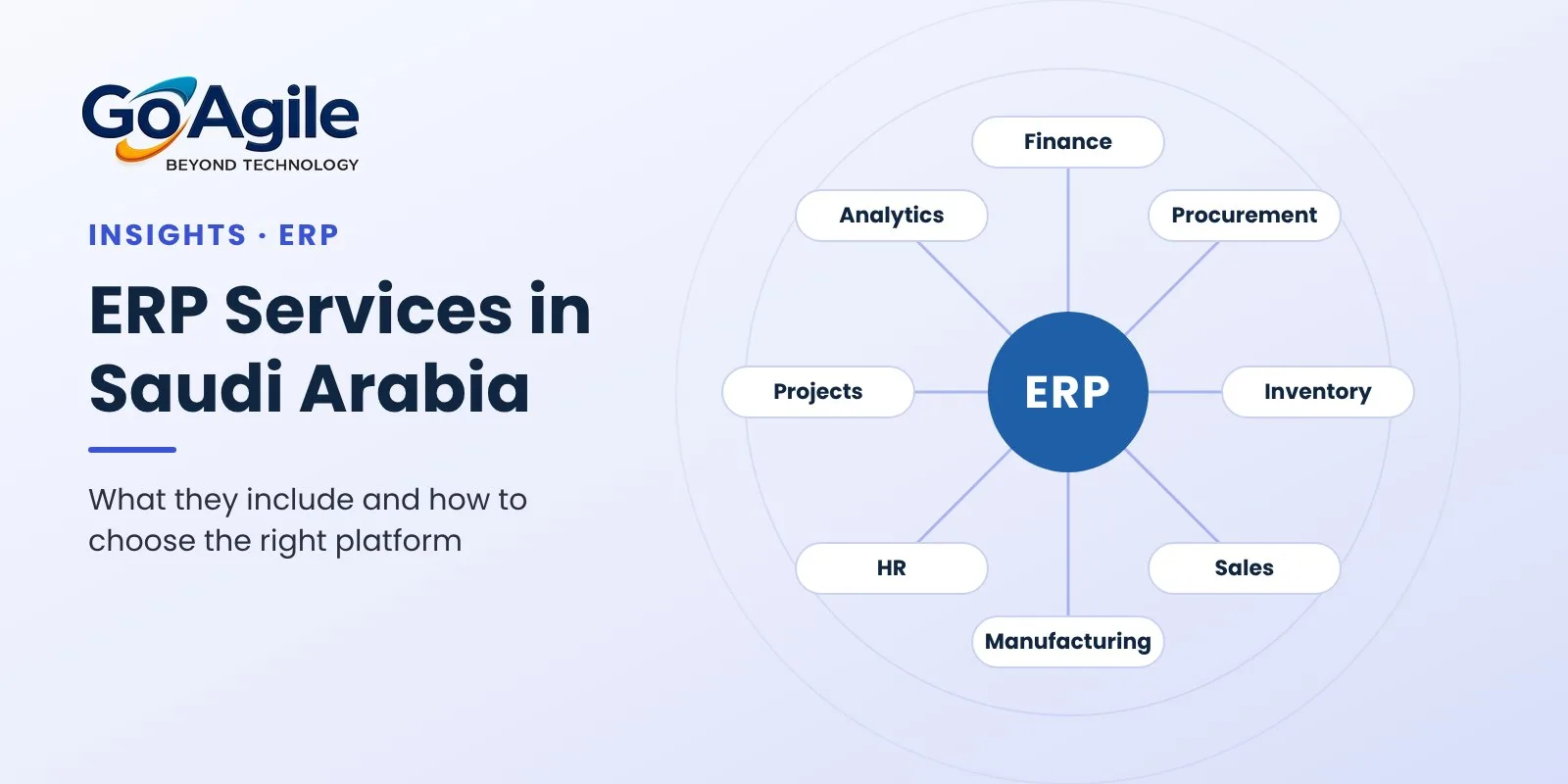
ERP Services in Saudi Arabia: What They Include and How to Choose the Right Platform
By Habeebah Salman | Content writer, GoAgile Technologies
ERP services are the consulting, implementation, customization, integration, data migration and support work that makes an ERP system fit the way your business actually runs.
This guide explains what ERP is, what the main modules do, what ERP services include, and how to choose between the seven platforms GoAgile implements: Dynamics 365 Finance & Operations, Dynamics 365 Business Central, Odoo, Oracle, SAP, TallyPrime and Zoho. It is written for business owners, finance heads, IT managers and students in Saudi Arabia and the GCC.
Quick answers
- ERP (enterprise resource planning) puts finance, purchasing, stock, sales, production and HR on one system with one set of records.
- ERP services cover the whole journey: advice, setup, custom work, connections to other systems, moving your old data, upgrades and support after go-live.
- No platform is best for everyone. The right one depends on your size, number of entities, how much customization you need and who will support it.
- In Saudi Arabia, also check how a platform handles local requirements such as ZATCA e-invoicing before you sign.
What Is ERP and Why Do Businesses Use It?
ERP stands for enterprise resource planning. It is business software that runs your core processes, such as accounting, purchasing, inventory, sales, manufacturing and HR, on a shared database, so every team works from the same numbers (IBM overview of ERP).
Here is a simple illustration. A distributor confirms a sales order. In a connected ERP, the warehouse sees what to pick, finance sees the invoice to raise, and purchasing sees whether stock needs reordering, all without anyone re-typing the order. Without ERP, the same order often sits in three spreadsheets that slowly drift apart.
For more basics (ERP vs CRM, cost and timelines), see the FAQ on our ERP Services page.
What are the main modules of an ERP system?
A module is one part of the ERP that handles a specific job. You switch on the ones you need and add others as you grow. These are the usual ones:

What are the benefits of ERP?
- One version of the truth. Finance, sales and the warehouse see the same figures.
- Less re-typing. Data entered once flows to every department that needs it.
- Faster, clearer reporting. Managers see live numbers instead of waiting for spreadsheets.
- Better control. Approvals, budgets and audit trails sit inside the process.
- Room to grow. You can add branches, entities and modules without changing systems.
How do you know it is time for an ERP?
- Teams keep their own spreadsheets, and the numbers never quite match.
- Month-end close takes days of chasing and reconciling.
- Stock in the system and stock on the shelf differ.
- You have several branches or companies and cannot see them together.
- Data is copied by hand between sales, accounting and the warehouse.
- Simple questions, such as profit by project, take hours to answer.
What Do ERP Services Include?
ERP software is only half of the project. ERP services are the work that gets it configured, connected and adopted. These are the usual building blocks:

How does an ERP project run, step by step?
- Map how your teams work today. Approvals, exceptions and manual workarounds all matter here. This shapes the platform choice.
- Choose the platform and agree the scope. Decide which modules go live first, and fix milestones and responsibilities in writing.
- Configure and customize. Set up the standard system first, then add only the custom work you can justify.
- Clean and migrate your data. Fix duplicates and outdated records before they move, not after.
- Test with real scenarios and train users. Run actual orders, invoices and month-end tasks, and train each role on its own tasks.
- Go live, then support and improve. Plan help for the first weeks and the next phase of rollout.
What are the most common ERP mistakes?
Troubled ERP projects tend to trace back to planning, data quality and change management more than the software itself. In practice that looks like this:
- Skipping process mapping, so the system is configured around assumptions.
- Moving dirty data, which makes the new system untrustworthy from day one.
- Over-customizing, which makes upgrades slow and costly.
- Training too late, so people go back to their spreadsheets.
- Rushing the timeline, which cuts testing first.
- Having no support plan, so small issues pile up after go-live.
How Do You Choose the Right ERP Platform?
Start with your business, not the brand. The table summarizes the seven platforms we implement and who each usually suits. Treat it as a starting point for a conversation, not a verdict.

Which questions narrow the choice fastest?
- How many legal entities, branches and currencies do you run?
- Do you need manufacturing, project costing or a complex supply chain, or mostly accounting and stock?
- How much will you customize, and who will maintain it?
- Does your team already work in Microsoft 365, Zoho or Tally?
- Do you want cloud, on-premises or a mix of both?
- Who supports the system after go-live?
If your answers lean towards accounting, stock and quick compliance, TallyPrime or Zoho are natural first looks. If you want modules you can switch on as you grow, look at Odoo or Business Central. If you run many entities or heavy operations, compare Dynamics 365 Finance & Operations, SAP and Oracle. A short gap analysis against your real processes will usually settle it.
Cloud, on-premises or hybrid?
Cloud ERP runs on the vendor’s or a partner’s servers and is usually paid as a per-user or usage-based subscription. On-premises ERP runs on your own servers and is typically paid for upfront as a licence. Hybrid combines the two (TechTarget on ERP deployment types). The right choice depends on your IT team, data policies and budget pattern, so decide it early.
How Do ERP Needs Differ by Industry?
The core modules are similar, but each industry leans on different ones. Typical focus areas:

Industry-specific ERP ships with these workflows already configured, which shortens implementation and reduces customization compared with adapting a general-purpose system.
What Should You Know About ERP in Saudi Arabia?
One local point deserves a check early: e-invoicing. Saudi Arabia’s ZATCA runs a two-phase e-invoicing programme, and the second phase requires your invoicing system to connect to its FATOORA platform. It is rolled out in waves, and the latest, Wave 25, covers businesses with VAT-subject revenue above SAR 187,500 in any year from 2022 to 2025, with an integration deadline of 1 February 2027 (ZATCA announcement; KPMG Saudi Arabia).
Ask every ERP provider how your platform and edition will handle it. For the details, see our e-invoicing solutions for KSA, UAE and Oman. Also ask about Arabic and English support in invoices, reports and screens.
How Do You Choose an ERP Partner?
The platform matters, but the people configuring it decide how smooth your first year is. Ask any provider:
- Which platform would you recommend, and why not the others? A good answer refers to your processes, not their price list.
- What is in the fixed scope, and what counts as a change request?
- How will you clean and migrate my data, and who signs it off?
- How do you handle Saudi requirements, including e-invoicing and Arabic and English setup?
- Who stays with the project after go-live? Ask whether the people who scoped it also support it.
- How do you protect my data? Certifications such as ISO 27001 are a reasonable starting point.
- Can I speak to a client on the same platform?
ERP Services at GoAgile Technologies
GoAgile Technologies is based in Riyadh and works across Saudi Arabia and the GCC. Our ERP team implements and supports seven platforms. We start by understanding your requirements and recommending the platform that fits, rather than pushing one we happen to sell.
Which services do we provide?
Across platforms, our ERP services are consultancy and implementation, customization and enhancements, application integration, version upgrades, resource outsourcing and data migration. Support continues after go-live.
Which ERP platforms do we work with?
- Dynamics 365 Finance & Operations: including Dynamics AX and NAV, Dynamics 365 CRM, Power BI and Power Platform.
- Dynamics 365 Business Central: including LS Retail.
- Odoo ERP: implementation, customization, development, integration, migration, consulting, gap analysis, training and support.
- Oracle ERP: for large enterprises with deep financial and supply chain needs.
- SAP ERP: including SAP ECC to S/4HANA migration, SAP Business One, and support and AMC.
- TallyPrime: including TDL customisation and Tally.ERP 9 to TallyPrime upgrades.
- Zoho ERP: including Zoho One, Books, Inventory, CRM, People and Projects.
How do we run an ERP engagement?
We describe our approach in three stages: prepare (map people, process and platform before anything is configured), accelerate (agree milestones up front, run migration alongside implementation where the platform allows, and prioritize the modules that show value first) and sustain (the same consultants stay on for support, upgrades and the next rollout phase).
You can read what clients say on our testimonials page.
Conclusion
A good ERP project comes down to three things: a platform that fits your size and complexity, a clean process and data foundation, and a partner who stays after go-live. The modules and the technology matter, but the early work of mapping your processes and cleaning your data decides how smoothly everything else goes.
Not sure which platform fits? Tell us what you run today and what you want to fix, and we will come back with a scoped plan rather than a sales pitch. Talk to a GoAgile ERP specialist.
Sources
- IBM: What is ERP?
- TechTarget: ERP definition and deployment types
- ZATCA: Wave 25 announcement
- KPMG Saudi Arabia: Announcement of Wave 25
- GoAgile Technologies: ERP Services
Frequently asked questions
How much do ERP services cost in Saudi Arabia?
There is no single price, because scope drives cost. Cloud ERP is usually a per-user or usage-based subscription, and implementation is often the larger cost, covering configuration, data migration, integrations, training and support. Ask for a fixed scope with milestones so the budget does not move mid-project.
How long does an ERP implementation take?
It depends on scope, number of entities, data quality and integrations. For mid-sized and larger organizations it typically takes at least a few months, and it is often delivered in phases by site, entity or module rather than all at once.
Which ERP is best for a small business in Saudi Arabia?
There is no universal answer. Businesses that mainly need accounting, stock and quick compliance often start with TallyPrime or Zoho. Those who want modules to add as they grow often look at Odoo or Business Central. Run a short gap analysis against your real processes before deciding.
What is the difference between ERP implementation and customization?
Implementation sets up the platform for your business using its standard features. Customization adds what the standard system cannot do, such as special reports or local forms. Keeping customization small makes upgrades easier.
Do I need to replace my ERP, or can I upgrade or migrate it?
Not always. If your current system still fits your processes, a version upgrade or integration work may be enough. If it no longer does, for example an old SAP ECC or Tally.ERP 9 setup, a migration to a current platform is usually the better route. A gap analysis shows which case you are in.
Is cloud ERP secure?
Generally yes. Cloud ERP typically offers multi-layered encryption, strict access controls, continuous monitoring and independently audited compliance with frameworks such as ISO 27001 and SOC 2. Still, ask your provider where data is hosted and who can access it.
Does my ERP need to support ZATCA e-invoicing?
If you are a VAT-registered resident taxpayer, yes. Phase 1 already applies to you, and Phase 2 applies once ZATCA notifies you under your wave. Ask your partner how your platform and edition handle it.